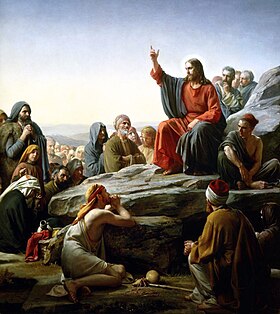
I will briefly step aside from my Lord of the Rings analyses to discuss a topic that I feel is far more important at this time. A little background first. I was blessed to have a mission president who's first priority was his missionaries and their personal preparation in order to teach most effectively. One of his favorite methods of doing this was to talk about the Doctrine of Christ in every meeting. How missionary work is connected to the Doctrine of Christ was discussed in a previous post. However, the Doctrine of Christ is central to all we do, and my mission president knew that. During one zone conference in January of 2012, he challenged us to mark in the Book of Mormon all the different parts of the Doctrine of Christ over the next 6 months. It was truly an amazing experience and it grew my testimony. Fastforward about 7 months to the present day. I am currently taking a New Testament class at BYU, which has been extremely interesting. My professor addressed the Sermon on the Mount and the Beatitudes in a way that I had never thought of before. It involved the Doctrine of Christ and how Christ is always teaching about it. We have to keep in mind, however, that this case, the Doctrine of Christ is mostly focused on what happens when we join the Church. I will discuss this in this post.
Surprising, I don't begin the Sermon on Mount analysis in the account of Matthew. I first turn to the account given in the Book of Mormon, which really starts off the Doctrine of Christ. 3 Nephi 12, known as the Sermon at the Temple, gives a different beginning, yet it starts off the process.
"And again, more blessed are they who shall believe in your words because that ye shall testify that ye have seen me, and that ye know that I am. Yea, blessed are they who shall believe in your words, and come down into the depths of humility and be baptized, for they shall be visited with fire and with the Holy Ghost, and shall receive a remission of their sins."
Christ starts out the Sermon at the Temple with faith in hearing the His word. When we are humble, we repent on our sins. He then tells us that we are blessed when we are baptized and receive the Gift of the Holy Ghost. We see the first 4 parts of the Doctrine of Christ just in this one verse. However, the rest of the Beatitudes are very enlightening as to what we need to do after we complete these first parts of the Doctrine of Christ.
"Blessed are the poor in spirit..." An interesting thing about the poor in spirit is that they have continuing faith. The poor in spirit are the ones who aren't caught up in the world because they are focused on Christ. He strengthens the poor and makes them strong.
"Blessed are they that mourn..." This one is an interesting one because it depends on what your definition of "mourn" is. In this context, it represents godly sorrow. When we commit sin, part of repentance is that we feel sorry for the things we have done. It is this mourning for our wrongdoings that drives us to repent.
"Blessed are the meek..." I think probably the best definition of "meek" is "teachable". We see that those who are repentant are those who are teachable. When we are teachable, we are open to the Spirit and we can be guided to what we need to do to be fully forgiven for our sins.
"Blessed are they which do hunger and thirst after righteousness..." For those who are repentant, a key is to seek after the righteous things of the world. We have to remove ourselves from the evil influences of the world and replace those things with the good. In order to do that, we have to actively seek after those things that will bring us closer to God.
"Blessed are the merciful..." I have been told that one of the ways to gain charity is to repent. When we repent, we feel the love of the Savior and in turn, share that love with others. We become as the Savior would, merciful and charitable to all of God's children.
"Blessed are the pure in heart..." In this context, the definition of pure in heart is "changed". When we allow the Atonement to purify our hearts, we are forever changed from our baser state to a higher plain of holiness. The scripture further teaches that the pure in heart will see God. This is because God cannot look on sin with any degree of allowance. Since we all sin, we all have to be changed to be pure in heart.
"Blessed are the peacemakers..." Having met many people in my life, I have come to recognize that people either are ready for confrontation or ready to make peace. It is the humble that are the peacemakers. The humble are the ones willing to submit to the Lord's will and try maintain that peace in their lives. Peace-making is also an individual thing. We help ourselves feel peace when we repent and feel the Spirit. We are peacemakers when we strive to maintain that.
"Blessed are they which are persecuted for righteousness' sake..." Quite simply, this is enduring to the end. When we endure persecution, we are following the Savior's footsteps. If we endure the persecution, the scripture promises that we shall inherit the kingdom of heaven.
The Beatitudes truly exemplify how we should repent and how the Savior taught His Doctrine. My BYU professor called this the "Process to Perfection". In the long run, each one is a step on a ladder. We can't reach the next one without having gone through the previous ones. This process can take a lifetime, if not more to accomplish. However, if we follow the Savior's teachings, it will be possible.